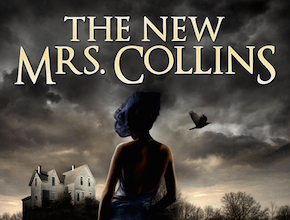
Leena has been looking forward to marrying the father of her child since he proposed on bended knee during a vacation in Myrtle Beach. Now the big day has arrived, Leena looks beautiful in her wedding dress, the church is packed with her loved ones, and happily-ever-after is barely a few “I dos” away.
Except Leena’s fiancé never makes it to the church. It turns out he’s fallen in love with another woman. A beautiful, poised, accomplished woman called Adira. And instead of running away, shamefaced, Leena’s cheating fiancé moves Adira into town and quickly marries her.
It’s a combustible situation, especially in a small, Southern town where people make a point of knowing (and sharing) their neighbours’ business.
Leena, hurt and humiliated, cannot let the betrayal go. But when she goes looking for dirt on Adira she uncovers secrets better left hidden and soon understands that it doesn’t pay to anger the new Mrs Collins.
Quanie Miller’s Southern Paranormal novel is a fantastically fun read. The narrative tugs you into the close-knit town of Carolville, introduces you to the quirky line-up of residents, then whips up a storm with the mysterious Adira.
Leena was no slouch in the looks department, but she could see why Johnny had been tempted! Adira had a behind that God made on the first day and hips he must have made on the second. And she didn’t walk; she sashayed, like she had honey between her thighs. The men near the moving vans watched her like they knew about the honey and were trying to figure out the most polite way to ask for some.
The tale is gripping and fresh, a new twist on a familiar tale. Man leaves old partner for new partner, man gets more than he bargained for.
Quanie has a particularly charming way with dialogue. Listening to her characters talk gives the story texture, it peels away whatever location you’re in and drops you into the sticky heat of the Deep South.
“Everyone in this town knows there’s something about that girl that would shake the devil himself.”
“Is it hoodoo?”
Mrs Ducet threw her head back and laughed. “Honey, she ran all those women out of town! Hoodoo is something that people study. Pluck a strand of hair, make a doll, learn a spell, what have you. Whatever that child is, she was born that way.”
The characters are rich and authentic. I found Leena, the jilted bride a spirited, sympathetic woman with real backbone. And interestingly, Quanie gives Adira a voice too, a great creative choice as it adds layers and dimensions to the conflict.
In short, The New Mrs Collins is a fascinating story, populated with strong characters embedded in a intriguing world where the atmosphere successfully shifts from light-hearted to eerie without losing pace or plausibility. It’s a wonderful read. Add it to your book list.
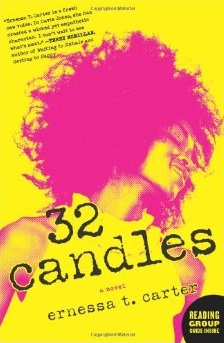
When I described the opening of 32 Candles to a friend –poor, dark-skinned, black teen obsessed with John Hughes films and their happy endings dreams about being the star of her own fairy tale romance – my friend said: “That sounds like a book about you.” I chose not to take offence to her comment, after all, it’s 95% true.
I love the novel’s lead character Davie Jones because like me she grew up on Pretty In Pink and The Breakfast Club and harboured the quiet hope that one day a gorgeous, charismatic guy would recognise the light hiding under her bushel and whisk her away from her hum-drum life. Unlike Davie Jones I did not grow up in Nowhere, Mississippi, the daughter of an alcoholic mother. I did not spend most of my childhood a selective mute after a traumatising incident. I was not called Monkey Night by colour-struck classmates. And I never made a play for the most popular boy town that went so badly wrong I was forced to flee town in the dead of the night.
Davie Jones moves to LA where she becomes a jazz singer. She resigns herself to an uneventful existence, but fate has other plans. Soon the bullies she left behind are reappearing in the most unexpected places and her dreams are once more within reach.
32 Candles is my favourite book this year. The prose is fun and frothy and rattles along at a swift clip. Davie Jones is resilient, bold, daring and determined to take her turn in the spotlight even in a world that says black girls don’t deserve magic.
The book is divided into five sections:
Then
In Between Then and Now
Now
In Between Then and Now (the amendment)
Back To Now
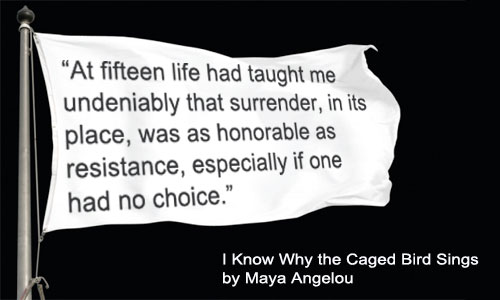
It’s a clever sequencing that manipulates chronology to thwart reader expectations and ramp up the tension. The combination of a Hollywood-worthy plot with thought-provoking themes adds up to a story that’s layered and interesting without being dogmatic or heavy. It’s like The Colour Purple meets I Know Why The Caged Bird Sings meets Molly Ringwald. Trust me, you’ve never read anything like it.
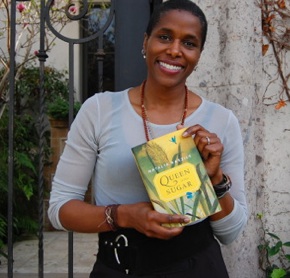
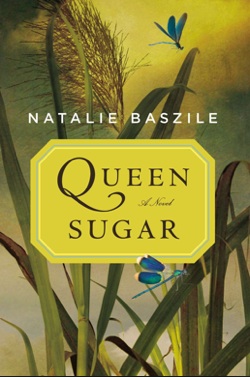
Charley Bordelon is a widow and single-mother. When she inherits a sugarcane farm from her father she opts to leave her failed life in LA behind, pack up and move in with her grandmother in Louisiana. Unbeknownst to Charley her grandmother has also invited her half-brother, Ralph Angel, to stay – a bitter man angry at being excluded from his father’s will. As tensions escalate at home, Charley must also contend with a host of problems on her new farm. Between the acres of neglected and dying crop and her hostile neighbours both black and white, she soon wonders if this is a feat she can pull off.
The notion of a black woman owning a sugarcane farm in the Deep South a century after The Great Migration lends itself wholly to drama and conflict. When you throw in a bunch of charismatic relatives the stakes get even higher and the end result is highly compelling.
I found Charley flawed and relatable and could only admire her tenacity:
“She joined the crew, pulling armloads of cane stalks off the back of the wagon. The men looked at her as though she’d lost her mind, whispered in Spanish, but there was no time to explain.”
The writing is packed with sensory observations that transported me into the Louisiana heat:
“Charley raised the dirt to her mouth again. She sniffed: wood, smoke, grass, damp like a sidewalk after it rained. She tasted grit, fine as ground glass, chocolate, and what? Maybe ash? She closed her eyes as soil dissolved over her tongue, and slowly, slowly, almost like a good wine, the soil began to tell its story.”
Queen Sugar is a story of transformation, of courage, of redemption and of living your best life. An absorbing gem of a tale.
I was startled to read a tweet today saying Malorie Blackman had closed her Twitter account after a deluge of racist messages.
Here’s what happened.
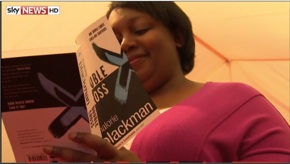
The Edinburgh International Books Festival was held last weekend and in her capacity as children’s laureate Malorie Blackman did the media rounds talking up UK books, but also highlighting the lack of ethnic diversity in children’s publishing.
She told Sky News that a lack of diversity in books can discourage children of colour from reading and make them feel excluded:
“I think there is a very significant message that goes out when you cannot see yourself at all in the books you are reading.
“I think it is saying ‘well, you may be here, but do you really belong?”
A sub editor at Sky decided to title the story with the provocative and inaccurate headline: Children’s Books ‘Have Too Many White Faces’ says Malorie Blackman, which was all the invitation the internet trolls needed.
Malorie received an avalanche of racist criticism on her Twitter feed.
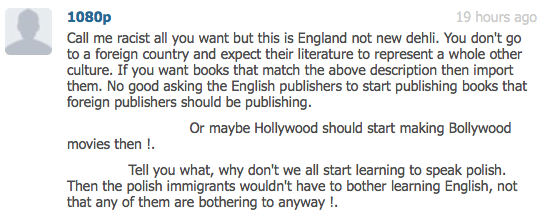
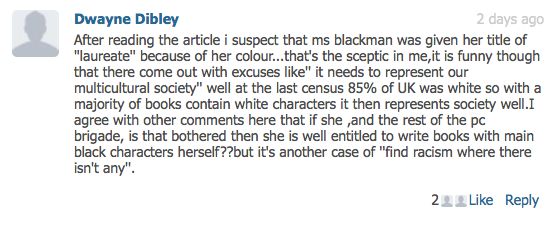
And responses to the story on Sky’s website vacillated between nasty and ignorant:
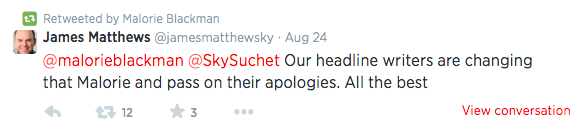
Malorie complained to Sky News and they changed the headline to reflect her actual comments, but the damage was done.
It’s remarkable the number of people who took that first headline at face-value, didn’t bother to read the story and decided that an expansion of ethnic diversity in publishing would somehow mean the marginalization of white characters and authors.
The ignorant commentators aren’t the real issue, neither is Sky News’ clumsy attempts at sensationalism. All of that simply distracted us from Malorie’s key point, that children’s publishing in the UK is overwhelmingly white and does not reflect the population.
“There is still an attitude among some editors and booksellers that they can only sell a book to the people they decide a book is aimed at,” Malorie told the Guardian newspaper last week. “But being British means a lot of things and especially at the moment, people need to feel they have a stake in society. A brilliant way to do that is through books.”
Such sound logic. Particularly now, when it seems the entire world is fighting over ideologies and we could all do to walk in our neighbour’s shoes and see a different perspective. Publishers will say that black books don’t sell, that black children don’t read, that white children aren’t attracted to books with characters that don’t look like them on the cover.
Utter rubbish! Children will read anything with a good story. Malorie’s Noughts and Crosses has sold millions across the globe proving the point. Children will read outside of colour lines, gender lines, religious lines if we teach them to. And they’ll carry that open-minedness into adulthood. But they need variety on the bookshelves to develop those habits and that means authors, commissioning editors, illustrators, marketing teams, booksellers and parents need to be intentional about creating a publishing industry that reflects the diversity of the world we live in.
I hope Malorie will eventually come back to Twitter. We need her voice to keep speaking up about the dangers of a single story.
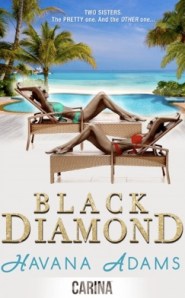
A set of twin babies wind up in a South African orphanage after their parents are killed. Lola is strong and beautiful and quickly adopted by a famous American actress. Grace is sickly and expected to die. She survives and is eventually adopted by an abusive church pastor and taken to live in England.
The sisters grow into women as different as their new homes, Lola follows the Lindsay Lohan Guide to Celebrity Living, dating all the wrong guys, drinking like a fish and stumbling through one scandal after another. Grace is overweight, timorous and unlucky in love. What will happen when their worlds collide? Will they find love and happiness? And, can they survive the secrets of their past?
While reading the first few chapters of Black Diamond I found myself doing that yelling-at-the-TV thing. Both Grace and Lola start out naïve, immature, manipulated by the people in their worlds. They learn every lesson the hard way (despite my yelled warnings) and it’s tough to watch them trusting and losing again and again.
The book had me hooked from the beginning. But a third of the way through it really hit its stride, that’s when I found myself picking up the e-reader to read a couple of pages and losing consecutive hours at a time. I don’t want to spoil the plot but this book would put any daytime soap opera to shame with the amount of sex, scandal and back-stabbing betrayal it packs in.
Havana has a great way with plot. The pace never falters, it simply switches up from ‘fast’ to ‘faster’. The characters are well drawn, and engaging (especially Nico. OMG. The guy is hot as Tabasco sauce in a kiln). The settings are vivid and glamorously varied and the writing is always engaging.
But Black Diamond is more than a sexy, galloping plot, it’s given depth by its meditations on identity and love and authentic living. I can’t recommend it highly enough.
Sometimes you read a novel and you come across a sentence, a phrase, a thought, and it gives you pause. Maybe the author has used language in a unique/unusual way or revealed a character so sharply they’ve leapt up and become corporeal. Or maybe the line has resonated so deeply you see your own life in the words.
When I have those moments I reread. And reread. Then wonder who I can share the words with.
Since it launched in March 2014, the web series An African City has attracted thousands of online viewers and scored a ton of critical acclaim for its bold approach to sex, its multifaceted female protagonists and its dazzling aesthetic.
I spoke to the show’s creator and writer, Nicole Amarteifio about her creative process, feminism and what it takes to fulfill a dream.
I was born here in Ghana. But shortly after the December ‘81 coup my family decided to leave. First we went to England, then after about seven years we moved to America where I spent most of my life. Even as a child growing up in America I always knew that I wanted to go home, and home was Ghana. So shortly after college I made the move back.
I remember one of my first bosses out of college, she loved my writing. It gave me that confidence, that bounce in my step. I started writing poetry and poetry turned into a chapter of a novel. When I was in grad school another professor was very encouraging, he showed me how to write screenplays. When I decided to do the African Sex and the City I thought of all the people who’d encouraged me in my writing. I could hear their applause.
I had no idea how to go about [creating a show]. I kept saying: “how am I, one day, going to pitch this to a big scary network?” My professor at grad school was like: “just write!” I took his advice and wrote and wrote and wrote. And then in Feb 2011 Issa Rae came out with The Misadventures of Awkward Black Girl and it just hit me like, ‘wow, I don’t have to go pitch my idea to a big scary network, I can just call some of my friends and we can put this on YouTube. YouTube can be our network’. That’s how I was able to take it from a dream to a reality.
I’m part of a network called Diaspora African Women’s Network – DAWN – made up of great women doing great things in African policy, etc. I mentioned to one of the members that I had this idea and she knew Millie [Monyo], she said: “Millie’s a TV producer in New York, she’s Ghanaian-American, you two should meet.”
Luckily Millie had had some experience working in TV production here in Accra. It was very important to me that we had a top quality production that was done by Ghanaians. Millie had worked on a production with Sparrow productions by Shirley Frimpong-Manso and had some connections so we hooked up with them.
It was [difficult]. We had auditions, first in New York. I have this philosophy that if you have a character who’s Ghanaian but raised in America you should have an actress who’s Ghanaian but raised in America. It was very important for me that the actresses really understood their characters. We found three of the girls in New York and then we had auditions here and that’s where Marie showed up. Marie we knew because she acts in Adams Apples which is very popular. And then Maame who plays Zainab, I just think she’s so beautiful and I went to high school with her for one year. I then bumped into her at an event and I said: “you have to be in my show. The camera will love you.” She didn’t audition, she didn’t even read. And she had never acted before. The other four actresses are professional actresses, trained in theatre and film etc so she says she got a lot of support on set from the rest of the cast.
We would meet with different designers and tell them the look of characters and they told us what they had that would fit character x or y. We were very lucky in finding a lot of designers who were very supportive of the show. That’s evident in all the great pieces we were able to get.
It was very important to me that when you look at the show you see designers from top African [fashion houses] and up and coming designers – Christie Brown, Ame’yo, Osei-duro. If you listen you’ll hear music that’s not from America, it’s not from Europe, these are African artists, on the continent who are producing and making wonderful music. It’s supposed to be a platform for all kinds of art.
In episode five – Nana goes to the hairdresser for a wash and blow dry and the stylist says they don’t do natural hair. That really did happen to me in 2006. I walked into a salon with natural hair and she looked at me like I was an alien. Things have changed now though, there are more and more salons that can handle natural hair.
It was very important to me to have the majority of characters have natural hair. Four of the five girls are natural. Reason being, when you look at black women on TV, when do you see a black woman with natural hair? Unless they are playing a period piece on slavery. I felt like that narrative had to be changed. You can be a black woman with natural hair and be glamorous, sexy, beautiful.
The five women have jobs. They’re great at the work they do, that’s what enables them to afford their lifestyles. When you get to a certain age and you don’t have children, that’s a lot of disposable income. I put a lot of my own savings into doing this web series. If I had a child I wouldn’t have been able to afford that. That’s how I see the girls. They’re women with good jobs that pay well so they’re able to wine and dine at the best restaurants.
Everyone in the production crew except for the production assistants were male. However, it meant they had a great take on the show. If they were laughing, if they were relating, it was a great sign. It was like testing the market. We would do a scene and I’d get the male perspective. In the writing process there were so many women from my life involved. It was actually a nice balance for this production.
Working in international development, I only see the story of the African woman who lives in poverty, who has HIV, who has kids and you need to advise her on how to provide the best for her child’s health, ie use those mosquito nets. It was just one story of the African woman and I wanted to change that narrative. I wanted to show that there are African women who are smart, witty, intelligent, classy, glamorous, there’s another story. There are some people who complain that I went too far, but the way I see it, the next filmmaker can come up and show a middle ground. There’s room for many, many stories.
What I love about the series is that yes there are things that might be unique to the African woman but in the same breath many things are common to all women. I know that for me, as a returnee, I can be sitting in the hair salon and my hair stylist who has never left Ghana has never been to America, she’ll be complaining about her boyfriend in the same way that I complain about my experiences. It’s the same. Unbeknownst to my hair stylist, the same things she’s saying I’ve heard from female CEOs in New York. You can be sitting in Kansas or sitting in Accra and there’s some family member who’s pressuring you about marriage and babies. It’s a global experience, all part of the collective sisterhood.
The big thing to me about Ghana society was realising that it really is a man’s country. The issue of being faithful in a marriage – that is probably what shook me when I got back here. There’s a lot of adultery that happens in the United States but it just doesn’t feel condoned, but in Ghana it felt like it was okay, it was more acceptable. [The attitude was] If your man’s not beating you, what are you complaining about?
[Elsewhere] there are systems in place that if a woman wanted to complain about [sexual harrasment] she would be protected. Here I noticed that if a woman where to complain she would be looked at strangely, she would be ridiculed, she wouldn’t have the systems in place to really protect her. It’s those kinds of differences that are unfortunate.
These are short 15-minute episodes. I can easily write one draft in two days. I can fine tune it and get a final in three days. Then it’s always being edited. Something will happen when I’m driving to my local supermarket or I’ll get a phone call from a girlfriend that will inspire something and I’ll need to tweak something, so it’s always in the editing phase.
I want to have a [writing] team for season two. For me I like to write what I know. Some of the audience are asking for things that I feel like I can’t authentically write. The writing team is definitely going to grow.
Some Saudi prince will come and give us millions and millions of dollars to do a season 2, 3, 4, and 5. Did I say millions? I meant billions. That would be my dream for the show. We’ve just now started talking to TV networks but I don’t want any kind of compromise. If we do sell to a TV network it has to be financially viable and not a compromise. I love being on the web. In Ghana usually when things go on TV they can’t tell you how many people watched it, how long they watched it for, where in the country they were when they watched it. But on YouTube, you can get all that data. You see instantly how many people are watching, how many people are liking it. The social aspect of putting something on YouTube is great.
It’s summer. Unless you’re truly unlucky you have a few days of freedom coming up. While you’re lounging in the sunshine, sipping on that Mai Tai, you should read a book. Here are five fantastic suggestions:
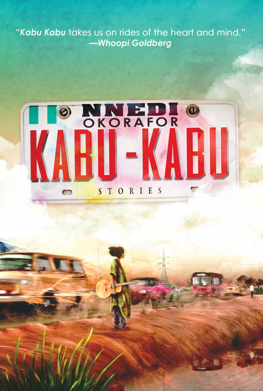
Kabu Kabu by Nnedi Okorafor
A young woman, desperate to catch her flight out of Chicago’s O’Hare accepts a lift from an illegal Nigerian taxi, a kabu kabu. Never mind that the taxi is far from its proper environs. She soon finds herself sharing the ride with a procession of unusual and unsettling characters.
Award winning-author Okorafor deftly combines everyday life with African folklore, juju fantasy and mystical realism to produce a remarkable collection of short stories.
Debbie Doesn’t Do It Anymore by Walter Mosley
After starring in hundreds of films, super porn-star Debbie Dare has been disillusioned for a long time and is starting to phone it in. Then, one day, not only does she unexpectedly pass out having the most intense orgasm of her life (and first in years) while filming a scene, she also returns home to discover that her husband and an underage girl are both dead in her bathtub after being electrocuted while filming an amateur sex tape. These events rock her world and sets into motion massive changes in her life.
Both fans of Mosley and newcomers to his work will be pleased.
‘Til the Well Runs Dry by Lauren Francis-Sharma
In a small village in 1940s Trinidad, 16-year-old Marcia is raising two boys on her seamstress wage. She is also guarding a family secret. Her life is soon upended by Farouk, a man so besotted with her he enlists a medicine-woman to guarantee his feelings are returned. What follows is a love story pounding with the sounds of Calypso, the scent of sea salt and spicy stews and the thrilling twists and turns of a relationship amplified by magic and threatened by global politics and family secrets.
Wife of the Gods by Kwei Quartey
“The forest was black and Darko was afraid to enter…”
So begins this lyrical Ghanaian mystery. DI Darko Dawson is ordered to investigate the murder of a young woman in Kentau, the town from which his mother disappeared many years before. Fighting an incompetent local policeman, superstition and a local priest to whom young women are given as trokosi or wives of the gods, Dawson sets about trying to solve both mysteries and prevent an innocent man from being hanged.
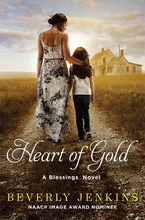
Heart of Gold: A Blessings Novel by Beverly Jenkins
The small Kansas town of Henry Adams was founded by freed slaves and rescued from bankruptcy by wealthy divorcee, Bernadine Brown. As part of her campaign to re-energize the town Bernadine offers a group of foster children permanent homes with town residents. Heart of Gold is the fifth novel in a joyful series that delivers heart-warming tales of family and friendship and prompts the reader to recognise how present these things are in all our lives.
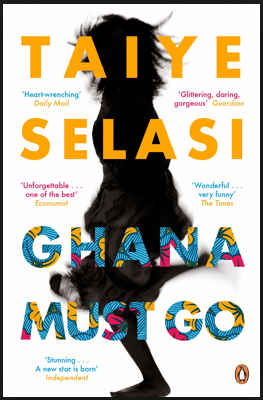
Taiye Selasi’s Ghana Must Go is not a page-turner. This isn’t necessarily a bad thing, sometimes it helps to take breaks while reading a book, it gives you the mental space to process the themes and concepts. That said, it took me over six months to finish this novel and I eventually did so not out of a compulsive desire to know the outcome, but out of obligation to my book club.
The story opens when Kwaku Sai, once a feted Boston surgeon, suffers a heart attack in his garden in Accra. He dies alone, regretful of his estrangement from his family. His departure sends ripples across the country to Sade, the wife he abandoned decades before, and over the ocean to his four children in America. Slowly, his death reunites the disjointed family and exposes the issues that drove them apart.
The writing is magnificent. Selasi explores family and love and guilt and forgiveness finding the words to ground intangible emotions and experiences. But is it too magnificent? Many a time I found myself marvelling over a descriptive passage only to realise it had pulled me from the story and driven off thoughts of the plot and characters. The pace of the narrative flagged under the weight of clever words and I found the prose kept me at arm’s length, always aware that a story was being woven before me.
The main thrust of the narrative relies on the isolation of the family members, on people not communicating but instead nursing secrets and personal tragedies until they grow toxic. There is no extended family to act as mediator, peacekeeper, truth-sayer. No uncles, no aunts, no grandparents to knit the fractured family back together. Sade’s half brother makes an appearance but largely as a plot device. Otherwise this half-Ghanaian, half-Nigerian family exists in isolation, solitary, insular. For an African family, barely one generation removed from the continent, I found the loneliness of this family a tough sell.
The individual characters were fascinating but inaccessible. I felt sympathy for the father who had let one mistake, a brief obsession, drive him from the people he loved most, but empathising with the cast of cold, ego-driven people was hard.
Despite my difficulty connecting with Ghana Must Go, I will anticipate Selasi’s next novel as eagerly as I did this one. I think she’s an extraordinary writer and I’m sure the issues that made this novel an uphill climb for me will even out over time.
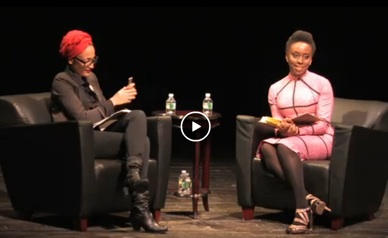
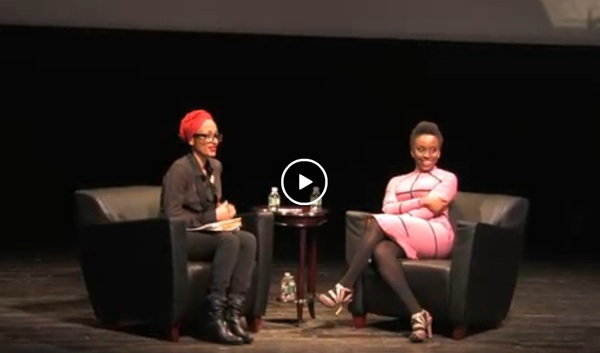
In March 2014 Zadie Smith sat down with Chimamanda Ngozi Adichie to discuss Adichie’s award-winning novel, Americanah. The conversation, (held at the Schomburg Center for Research in Black Culture), was just as fascinating and provocative as you might wish.
 Leena has been looking forward to marrying the father of her child since he proposed on bended knee during a vacation in Myrtle Beach. Now the big day has arrived, Leena looks beautiful in her wedding dress, the church is packed with her loved ones, and happily-ever-after is barely a few “I dos” away.



























 Coffee Bookshelves